

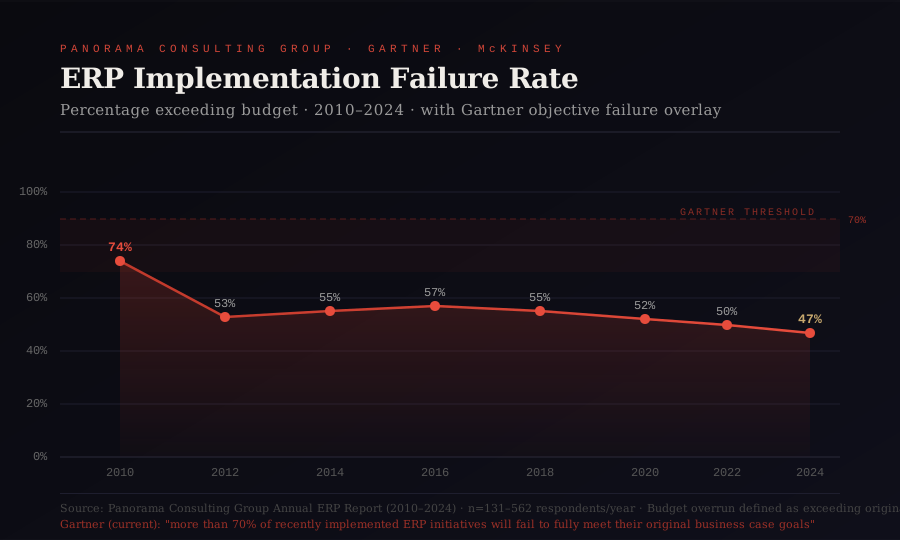
The global ERP market reached $64.83 billion in 2024 and is growing at 11.3% annually. By 2030, analysts project it will exceed $100 billion. Gartner simultaneously states that more than 70% of recently implemented ERP initiatives fail to fully meet their original business case goals, with 25% failing catastrophically.
A $100 billion market where the majority of its buyers fail to obtain what they paid for.
The industry has an explanation for this. It has had the same explanation since 1995. And it names, without exception, the customer as the responsible party.
The numbers, without the editorial framing
Before the argument, the data, because the data is the argument.
Gartner (current, from gartner.com): More than 70% of recently implemented ERP initiatives will fail to fully meet their original business case goals. Up to 25% will fail catastrophically. 75% of ERP strategies are not strongly aligned with overall business strategy.
McKinsey and the University of Oxford (2012): The largest empirical study of IT project outcomes ever published, 5,400+ projects analyzed in partnership with the BT Centre for Major Programme Management. Software projects specifically produced a 66% average cost overrun and a 33% schedule overrun. 17% of all large IT projects qualified as “black swans,” budget overruns exceeding 200%. Across the full sample, organizations captured 56% less value than their business cases projected. Total overrun across the sample: $66 billion.
Panorama Consulting Group (longitudinal, 2010–2024): The only annual ERP-specific study with consistent methodology. In their five-year aggregate (2010–2014, 562 respondents): 58% of ERP implementations exceeded planned budgets, 65% experienced schedule overruns, 53% of organizations achieved less than 50% of anticipated benefits.
The improvement trend is real but modest. Panorama’s 2024 report shows incremental gains in benefits realization. Gartner’s current projection, published after three decades of “best practices” iterations, remains above 70% failure.
Three decades. Same headline. Different brochures.
The machinery of blame
In 1995, John Kotter published “Leading Change: Why Transformation Efforts Fail” in the Harvard Business Review. The paper was not about ERP. It analyzed 100+ organizational change initiatives across a decade and identified eight common failure modes in broad corporate transformation.
Within 36 months, Accenture, Deloitte, IBM, and KPMG had adapted Kotter’s framework into a service line: Organizational Change Management, OCM, purpose-built for ERP implementations.
The strategic value of this adaptation was considerable. It provided a conceptual architecture that located the cause of ERP failure inside the customer organization, in its resistance to change, its inadequate sponsorship, its insufficient training budgets, rather than inside the product being sold. The consulting firms that built OCM practices were the same firms implementing the ERPs. The same firms collecting $2.30 to $4.00 in implementation fees for every $1.00 spent on software. SAP partners generate, by Alten Capital’s ecosystem analysis, up to $7 for every $1 of SAP revenue.
The incentive structure of this arrangement is not subtle.
Deloitte currently has over 12,000 SAP practitioners and describes change management as “the single biggest failure point” for ERP projects. Deloitte also has a 40-year partnership with SAP. The firm earns substantially more from implementation failures that require extended remediation contracts than from implementations that deliver value on schedule.
The academic literature absorbed the change management narrative with insufficient resistance. Aladwani (2001) applied marketing resistance models to ERP adoption, framing user non-compliance as equivalent to consumer product rejection. The paper influenced hundreds of subsequent studies. The framing became foundational: ERP failure is a people problem. The product is incidental.
Here is what the same academic literature reveals when you read further than the abstract:
Coşkun, Gezici, Aydos, Tarhan, and Garousi (2022) published “ERP failure: A systematic mapping of the literature” in Data & Knowledge Engineering, covering 72 peer-reviewed articles. Their taxonomy of failure factors includes, alongside change management: ERP system misfit with organizational culture and structure, high system complexity, functionality problems with the system, wrong ERP product selection, lack of vendor support, and poor consultant effectiveness. The vendor-side variables are present. They are consistently underweighted in industry communication.
A 2013 paper in Procedia Technology (“The Impact of ERP Partnership Formation Regulations on the Failure of ERP Implementations”) identified that the easy partnership conditions set by ERP vendors, specifically SAP’s partner certification model, are among the main contributing factors for ERP project failure. The authors described their finding as “novel since most related work attributes failures to other factors, ignoring the vendor-partner terms and conditions.”
Novel, in 2013, to suggest the vendor bears responsibility for vendor product failures. That is the depth of the paradigm.
What the courtrooms recorded
Academic literature operates under norms of measured language. Litigation does not.
Waste Management v. SAP (2008): Waste Management sought $500 million in damages. The complaint alleged that SAP provided a “rigged and manipulated” software demonstration before contract signing, and that the product delivered was “undeveloped, untested and defective.” Senior SAP executives, including Americas CEO Bill McDermott, were named as participants in the fraudulent demonstration. SAP settled. No admission of fault was published. The narrative that reached industry media focused on “implementation challenges.”
Marin County, California v. Deloitte Consulting (2010): The county sought $30–35 million after a failed SAP-based payroll implementation. The complaint stated that Deloitte “was utterly incapable of providing the necessary expert advice” and had “staffed the project with dozens of neophyte consultants, many of whom lacked even a basic understanding of SAP.” The county characterized Marin as a “trial-and-error public sector training ground” for Deloitte’s junior staff. The error rate on the new payroll system was approximately five times higher than the legacy system it replaced. Deloitte settled. Marin recovered $3.9 million of the $30 million sought.
Lidl and SAP (abandoned 2018): Over seven years and an estimated €500 million, Lidl attempted to implement SAP’s retail module. The project was abandoned entirely. The core reason was architectural, not cultural: Lidl’s pricing logic, based on purchase price rather than retail price, was structurally incompatible with SAP’s inventory valuation approach. Lidl reverted to its legacy system. SAP’s architecture made an assumption about how retail pricing works. Lidl’s business did not conform to that assumption. The product failed. No change management program prevents architectural misfit.
Oregon v. Oracle (2014): $200 million sought for the failed Cover Oregon healthcare exchange. Oracle settled for $100 million.
National Grid SAP Overhaul: Budget expanded from $383.8 million to nearly $1 billion. The system at go-live required 450 additional contractors for payroll problems and 400 more for supply chain and financial issues. A New York Public Service Commission audit documented the failure in detail.
The pattern across these cases is consistent. The vendor delivers a product whose assumptions do not match the customer’s operational reality. The customer, having paid tens or hundreds of millions of dollars and having no viable exit path, absorbs the failure cost. The vendor acknowledges no fault. The next sales cycle presents the product as the solution to the problems it created.
The economics of captivity
The change management narrative would be less durable if switching ERP vendors were straightforward. It is not, and the reasons are structural.
Oliver Williamson, the 2009 Nobel laureate in Economics, developed the concept of asset specificity in The Economic Institutions of Capitalism (1985). An asset specific to a transaction has higher value inside that transaction than outside it. Enterprise software creates multiple layers of asset specificity simultaneously:
Human asset specificity: employees develop deep expertise in vendor-specific systems, SAP ABAP programming, Oracle PL/SQL, proprietary workflow logic. This knowledge does not transfer across platforms. Carl Shapiro and Hal Varian termed it “wetware” in Information Rules (1999), and identified it as the most costly lock-in category to replicate.
Technical asset specificity: custom code, proprietary integrations, vendor-specific APIs, data formats that require vendor tools to read and transform.
Temporal asset specificity: once an implementation is underway, typically 15+ months in duration, the cost of mid-course abandonment exceeds the cost of completion even when the completion yields a deficient product.
Shapiro and Varian documented the commercial consequence: “The profit associated with a customer can be estimated as the total switching costs associated with that customer.” The incumbent vendor can price any renewal, upgrade, or support contract up to the full value of switching costs before triggering defection. The market does not clear on product quality. It clears on the distance between tolerable dissatisfaction and unbearable switching cost.
The data on actual switching confirms the model. Typical ERP system lifespans are 10–20 years, with the majority of enterprises remaining on the same core platform for 10+ years after initial implementation. Full replacement costs for a mid-sized organization range from $40,000 to $2,000,000, before accounting for implementation fees, data migration, retraining, and the productivity losses of the transition period.
SAP’s current migration strategy for its S/4HANA platform makes the mechanism explicit: SAP announced end of mainstream ECC support for December 31, 2025, with broader ECC end-of-life in 2027. Customers with decades of SAP investment face migrating to a new platform at massive cost, or losing vendor support for the system running their core operations. Oracle has increased support costs from 4% to 8% of license value and is projecting increases toward 10%. Microsoft Dynamics 365 has implemented price increases of up to 177% in certain configurations.
This is not market dysfunction. This is the designed outcome of an industry whose business model depends on exit costs remaining higher than entry promises.
Who buys and who uses
There is a structural gap in enterprise software that the industry discusses in marketing language and avoids in product strategy: the buyer and the user are almost never the same person.
A CIO and procurement committee evaluate and purchase an ERP system. They assess feature lists, compliance certifications, reference customers, and total cost of ownership models produced by the vendor. They do not use the system. The financial analyst processing 200 invoices daily uses the system. The warehouse manager tracking inventory through three shifts uses the system. The HR coordinator processing payroll for 800 employees uses the system.
Scale Venture Partners documented this cleanly: “Enterprise software had historically been bad because buyers were not users. IT and procurement organizations did their best, but they didn’t or couldn’t know what users really wanted. They could compare feature lists, which is what an RFP/Q experience excels at, and thus bias buying decisions toward more documented features.”
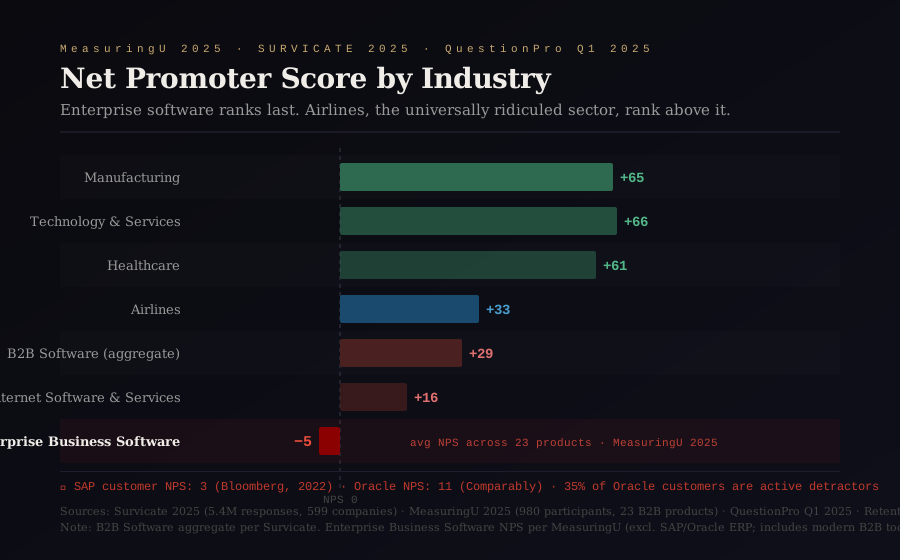
The satisfaction data reflects this gap in measurable terms. Gainsight’s Customer Success Index found executive buyers score a median NPS of 46 while end users score 36, a 10-point gap on the same system. MeasuringU’s 2025 benchmark of 23 business software products, 980 participants, found an average Net Promoter Score of negative 5, with individual products ranging from negative 38 to positive 24. Bloomberg reported SAP’s customer NPS fell to 3 points in 2022. Oracle’s NPS on Comparably stands at 11, with 35% of respondents classified as active detractors.
Adoption data confirms what satisfaction scores imply. Only 26% of employees fully utilize their company’s ERP capabilities. 26% do not use the system at all. Approximately 30% of software licenses are never activated. 91% of enterprise software errors trace to people using the software incorrectly or being insufficiently onboarded, a figure that the industry cites as evidence of training failure, and that also serves as evidence of catastrophic usability failure. Companies waste an estimated $21 million annually on unused SaaS licenses.
When the buyer is satisfied and the user is a detractor, the renewal contract favors the buyer’s experience. The user has no seat in the purchase decision.
The LATAM variable
The failure rates documented above apply primarily to North American and European enterprise software implementations, which are the primary population of most research studies. Latin America presents a structurally different and more severe version of the same problem.
EvaluandoERP, in its study of Latin American SMEs, documented a 70% failure rate for ERP implementations that failed to complete even after three or more years of effort. The researchers identified a specific behavioral response to this failure rate: paralysis, the suspension of decision-making driven by fear of a known catastrophe. Companies stay on inadequate legacy systems, or run operations on spreadsheets, because the visible failure rate of formal implementations makes inaction appear rational.
The regulatory environment amplifies the technical challenge in ways that standard ERP architectures are not designed to address. Brazil’s ongoing tax reform (2026–2033) is replacing multiple layered taxes, PIS, COFINS, ICMS, ISS, and IPI, with a consolidated VAT model. Every organization operating in Brazil is facing mandatory ERP overhaul regardless of whether their current system functions adequately. Mexico’s block list system means that an ERP incapable of processing compliant invoices can effectively halt an organization’s tax authority standing. Colombia’s 31% corporate income tax combined with demanding transfer pricing requirements creates compliance complexity that standard ERP modules handle through “standardized code releases” that Sovos characterizes as leaving companies to “adapt this code to their individual customizations, which can present an implementation nightmare.”
Each country in LATAM runs a different tax rate (10% in Paraguay to 34% in Brazil), different e-invoicing formats, different reporting cadences, different compliance update cycles. The ERP vendor who designed their system for a German or American regulatory environment and then sold localization packages as add-ons did not build these complexities into the architecture. They built them into the services agreement.
The LATAM ERP market reached approximately $1.75 to $2.17 billion in 2024 and is growing at 13.6% to 16.4% annually. Brazil alone accounts for 39% of regional revenue. Three vendors, SAP, Oracle, and TOTVS, control 77–83% of the Brazilian market. In that concentrated market, with high switching costs and complex regulatory requirements, the customer’s ability to exit a failed implementation is even more constrained than in North America.
The 70% LATAM failure rate is not a cultural artifact. It is the result of a North American and European vendor ecosystem applied to operating environments those vendors did not design for, sold by a consulting ecosystem earning the same implementation fees regardless of outcome.
What the data actually implies
The industry’s preferred conclusion from 30 years of failure data is that enterprise software implementation is inherently difficult and that customers must invest more in change management to succeed.
The data supports a different conclusion.
When the failure rate holds above 70% across three decades of documented “best practices” improvement, and when the industry publishing those best practices earns more from extended remediation contracts than from successful first implementations, and when the academic literature that challenges the change management narrative finds vendor-side factors present but systematically underweighted, and when litigation repeatedly documents product defects and manipulated demonstrations but produces no public accountability, and when the typical customer remains captive to a specific vendor for 10–20 years regardless of satisfaction levels, the explanation is not customer inadequacy.
The explanation is an industry that built its revenue architecture on exit barriers rather than on delivered value, and then constructed a conceptual framework that makes this extraction look like a service problem.
The change management narrative accomplished something elegant: it created a category of product failure for which the vendor bears no responsibility and the customer can always be blamed for not trying hard enough. Resistance is evidence that more change management was needed. Budget overruns are evidence that the customer underestimated the complexity of the change journey. Failure after seven years, as in Lidl’s case, was a product of architectural misfit that no change management program could have resolved, but the narrative had no structural category for that explanation.
The structural alternative
The buyer-user gap, the switching cost architecture, and the consulting industrial complex are not laws of nature. They are design choices embedded in how enterprise software has been built and sold since the 1990s.
Software designed with user experience as the primary quality signal, not features and compliance checkboxes, closes the buyer-user gap at the product level. Architectures that avoid proprietary data formats and allow genuine portability restructure the switching cost calculus. Business models that tie vendor revenue to realized business outcomes rather than license fees and implementation hours invert the incentive structure.
These are not hypothetical configurations. They are the operational principles of a small number of enterprise software providers who have built profitable businesses without external capital and without the consulting ecosystem that the major ERP vendors depend on.
The $100 billion ERP market growing at 11% annually is not evidence that the product works. It is evidence of how durable a business model becomes when exit costs are high enough to make satisfaction irrelevant.
The question worth asking is what happens to that model when the switching cost curve changes.
Simphony Technologies builds enterprise software solutions for organizations that have measured the cost of the status quo and decided to change the calculus. Based in Bogotá, operating across Latin America and the United States.